
Geometry Learn V3: The Ultimate Beginner’s Guide to Shapes & Angles (2026)

Geometry sits quietly behind almost everything you touch. The phone in your hand, the road you drive on, the chair you’re sitting in right now all of it follows rules of shape and space. If math class ever made geometry feel like a chore, this guide flips that. Geometry Learn V3 breaks the subject into small, friendly steps so you actually understand why the formulas work, not just how to plug numbers into them.
This article walks through every core idea you need, from a single point all the way to full 3D solids. You’ll find real examples, simple tables, and plain language throughout. No jargon overload. Just geometry explained the way a patient teacher would explain it over coffee. Whether you’re a student cramming for a test, a parent helping with homework, or someone brushing up out of pure curiosity, this geometry study guide has you covered.
What Does Geometry Learn V3?
Geometry Learn V3 is a fresh, structured way to approach shapes, angles, and measurement. Instead of throwing formulas at you and hoping they stick, it builds understanding step by step. Think of it as a geometry learning platform built around logic first, memorization second. Once you see why a triangle’s angles always add up to 180 degrees, you stop needing to memorize it. You just know it.
This approach works because it treats geometry as a visual subject, not a list of rules. You’ll sketch, compare, and connect ideas rather than just copy formulas onto flashcards. That’s what separates a real geometry tutorial from a dry textbook chapter, and it’s why so many learners find this method sticks longer than traditional cramming.
What Geometry Learn V3 Actually Means
At its core, Geometry Learn V3 means learning geometry through patterns and relationships instead of rote memorization. You start with basic geometry concepts, build confidence, and only then move toward harder material. Each new topic connects back to something you already know, so nothing feels random or disconnected.
Who Should Use Geometry Learn V3
Students preparing for quizzes or standardized tests benefit the most, but they’re not the only ones. Parents helping kids with homework, teachers looking for a clear geometry curriculum structure, and adult learners returning to math after years away all find value here. Anyone chasing stronger mathematical reasoning skills, really, can use this framework.
Why Geometry Learn V3 Is Popular in 2026
Visual and interactive learning tools have exploded in popularity, and geometry fits that trend perfectly since it’s inherently visual. People want geometry lessons that show rather than tell. Self-paced study has also become the norm, and a structured geometry course like this one lets learners move at their own speed without falling behind or feeling rushed.
What Is Geometry? A Beginner-Friendly Introduction
Geometry is the branch of math that studies shapes, sizes, positions, and space. Where arithmetic deals with numbers and algebra deals with unknowns, geometry deals with how things sit in space. It answers practical questions: how far apart are two points, how much paint covers a wall, how tall is a building based on its shadow. These aren’t abstract puzzles. They’re questions people solve every single day.
Once you start noticing it, geometry shows up constantly. Parking a car means judging angles and distance without a second thought. Rearranging furniture means estimating floor space and shapes. This is exactly why building geometry skills early pays off well beyond the classroom, into careers, hobbies, and everyday decision-making.
Why Geometry Matters
Geometry sharpens spatial reasoning, which is your brain’s ability to judge distance, size, and position. This skill carries into driving, sports, design work, and even packing a suitcase efficiently. Strong geometric reasoning also builds general problem-solving skills that transfer into other subjects, especially physics and engineering.
Branches of Geometry
Two main branches matter most for beginners. Plane geometry studies flat, two-dimensional shapes like triangles and circles. Solid geometry studies three-dimensional objects like cubes and spheres, which have volume. Both branches trace back to Euclidean geometry, the classical system built on points, lines, and provable rules that has shaped math education for centuries.
Real-Life Importance of Geometry
Architects use geometry to keep buildings standing. Athletes use it, often without realizing, to judge passing angles and shot trajectories. Video game designers rely on geometry to build entire 3D worlds out of digital shapes. This wide reach is exactly why geometry education remains a core part of every school’s math curriculum.
The Fundamental Building Blocks of Geometry
Before tackling full shapes, you need to know the raw materials that build them. Every triangle, circle, and cube on Earth traces back to a handful of simple ideas: points, lines and planes. These pieces might look too simple to matter, but they’re the alphabet of geometry. Skip them, and later topics stop making sense.
Learning this vocabulary early saves confusion down the line. Once you can confidently name a line segment versus a ray, reading geometry problems gets a lot easier. Consider this section your foundation-laying stage before the real shapes show up.
Points
A point marks an exact location in space. It has no length, no width, and no height. You’ll usually see points labeled with capital letters like A, B, or C. Despite being the smallest idea in geometry, points are where every single figure begins.
Lines
A line stretches forever in both directions. It has zero thickness and no endpoints at all. Interestingly, any two points determine exactly one line, which is a rule that shows up again and again in later proofs.
Line Segments
Unlike a full line, line segments have two fixed endpoints, so you can actually measure their length. The edge of a ruler is a perfect real-world line segment. Most shapes you’ll study, including every polygon, are built entirely from line segments joined together.
Rays in Geometry
A ray starts at one endpoint and shoots off forever in a single direction. Rays in geometry work a lot like flashlight beams: light begins at one source and keeps traveling outward without stopping. Two rays sharing a starting point is exactly how an angle gets formed, which you’ll see in the next section.
Planes
A plane is a flat surface that extends infinitely in every direction, like an endless sheet of paper. A tabletop or a computer screen represents just a small slice of what a true plane would be. Planes matter because most 2D shapes live entirely on a single plane.
Parallel Lines
Parallel lines run side by side and never meet, no matter how far you extend them. Railroad tracks are the textbook example, and for good reason: they stay the same distance apart forever.
Intersecting Lines
Intersecting lines cross each other at exactly one point. Almost every real-world grid, from city streets to graph paper, is built from lines that intersect at regular intervals.
Perpendicular Lines
Perpendicular lines are a special case of intersecting lines: they cross at exactly 90 degrees, forming a right angle. Window frames, plus signs, and city blocks laid out in a grid all rely on perpendicular lines to stay square and stable.
Geometry Symbols and Notation
Geometry symbols and notation save time once you know them. Instead of writing “line segment AB,” you can just write a short symbol and everyone understands instantly.
| Symbol | Meaning |
| • | Point |
| ↔ | Line |
| — | Line segment |
| → | Ray |
| ∠ | Angle |
| ≅ | Congruent |
| ∥ | Parallel |
| ⊥ | Perpendicular |
Understanding Angles Step by Step
An angle forms the moment two rays meet at a shared point called the vertex. Angles get measured in degrees, and a full circle always equals 360 degrees. Half of that circle is 180 degrees, and a quarter turn equals 90 degrees, which is your right angle. Getting comfortable with angle measurement is one of the most important basic geometry concepts you’ll learn, since angles show up in almost every shape you’ll study later.
Before jumping into radians or trigonometry, master degrees first. It’s the foundation everything else builds on. This section covers what angles are, how to measure them properly, and where beginners tend to slip up.
What Is an Angle?
An angle measures the amount of turn between two rays sharing a vertex. Picture opening a book. The wider you open the cover, the bigger the angle between the pages becomes. That’s essentially what you’re measuring every time you calculate degrees.
Types of Angles
Different angle sizes get different names, and knowing them instantly speeds up problem-solving.
| Angle Type | Measurement |
| Zero Angle | 0° |
| Acute Angle | Less than 90° |
| Right Angle | 90° |
| Obtuse Angle | Between 90° and 180° |
| Straight Angle | 180° |
| Reflex Angle | Between 180° and 360° |
| Complete Angle | 360° |
Measuring Angles with a Protractor
A protractor gives you an accurate degree reading in three simple steps. First, place the center point directly on the angle’s vertex. Second, line up one ray with the zero mark. Third, read the number where the second ray crosses the scale. Many beginners read the wrong scale by accident, so always double-check whether you’re measuring clockwise or counterclockwise before writing down your answer.
Common Beginner Mistakes
Small errors cause big problems in geometry calculations. Students often measure from the wrong starting point, forget the degree symbol entirely, or read the inner scale when they meant to read the outer one. Guessing instead of actually measuring is another common trap, and it almost always leads to wrong answers on geometry questions.
Real-Life Examples of Angles
Skateboard ramps, staircases, and clock hands all rely on precise angles to function safely and correctly. Even something as simple as tilting a laptop screen involves adjusting an angle until the view feels right. Once you start looking, angles are honestly everywhere.
Important Angle Relationships You Must Know
Many geometry problems become simple the moment you spot a familiar angle relationship. Rather than calculating from scratch, you recognize a pattern and solve it in seconds. This is where geometry starts to feel less like memorization and more like pattern recognition, which is exactly the goal of a good geometry learning guide.
Six relationships come up constantly on tests and in real design work. Learn these well, and a huge chunk of angle-based problems become almost automatic.
Adjacent Angles
Adjacent angles share one vertex and one common side, but they don’t overlap. Picture two slices of pizza sitting right next to each other. Together, adjacent angles often combine to form a larger, more familiar angle.
Vertical Angles
Vertical angles form when two straight lines cross each other, creating two pairs of opposite angles. Here’s the important rule: vertical angles are always equal, no exceptions. This single fact solves a surprising number of geometry problems instantly.
Complementary Angles
Complementary angles always add up to exactly 90 degrees. A 35-degree angle and a 55-degree angle, for example, are complementary because they total 90 together.
Supplementary Angles
Supplementary angles always add up to exactly 180 degrees. A 100-degree angle paired with an 80-degree angle is a classic supplementary example.
Linear Pairs
A linear pair is a special type of adjacent angles that together form a perfectly straight line. Because a straight line always equals 180 degrees, linear pairs are automatically supplementary too.
Angle Bisector
An angle bisector splits a single angle into two perfectly equal halves. Engineers and architects use this concept constantly when designing symmetrical, balanced structures like arches and support beams.
“Geometry isn’t just about measuring shapes. It’s about recognizing relationships.”
Parallel Lines and Transversals Explained
A transversal line is any line that crosses two other lines, and when those two lines happen to be parallel, something interesting happens: predictable angle patterns appear every single time. Learning these patterns turns lengthy calculations into quick observations, which saves serious time during exams and homework alike.
Four angle-pair types matter most here, and each one follows its own reliable rule. Once you know the pattern, you can often solve for a missing angle without doing any math at all.
Corresponding Angles
Corresponding angles sit in matching positions at each intersection point. When the two lines are parallel, corresponding angles are always equal to each other.
Alternate Interior Angles
Alternate interior angles sit between the two parallel lines, but on opposite sides of the transversal. Like corresponding angles, they’re always equal when the lines are parallel.
Alternate Exterior Angles
Alternate exterior angles sit outside the two parallel lines, again on opposite sides of the transversal. These angles are equal too, following the exact same parallel-line logic.
Same-Side Interior Angles
Same side interior angles sit between the parallel lines, but on the same side of the transversal. Unlike the previous pairs, these don’t match. Instead, they add up to 180 degrees every time.
Two-Dimensional Shapes Every Student Should Know
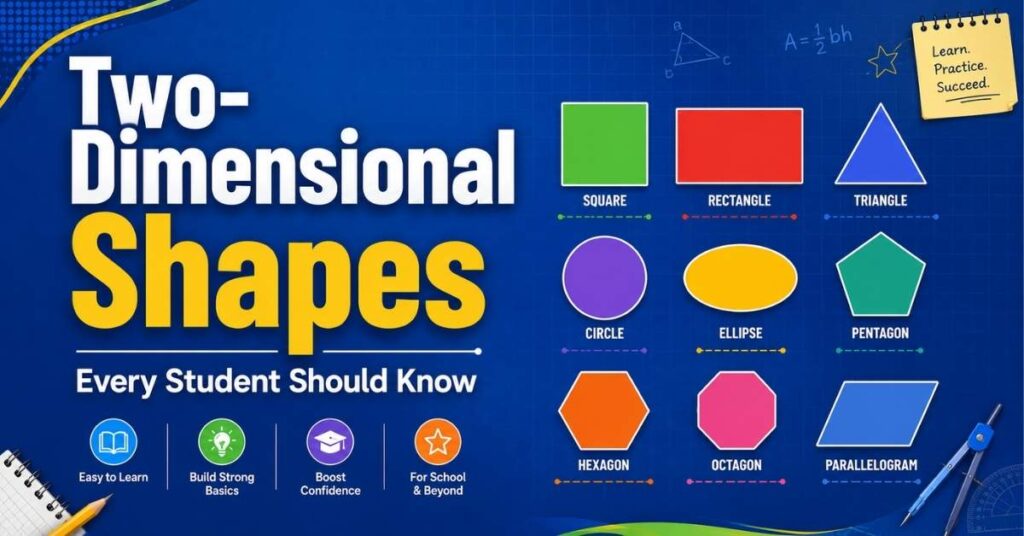
Flat shapes cover surfaces without any depth or volume, which makes them the easiest place to start building shape knowledge. Every flat shape made of straight sides falls under one simple category, and understanding that category unlocks dozens of related geometry concepts at once.
This section introduces polygons and the key ways they get classified. Once these labels feel natural, spotting shape properties in triangles, squares, and everything beyond becomes much faster.
What Is a Polygon?
A polygon is any closed shape built entirely from straight line segments, with no curves and no gaps. Triangles, squares, pentagons, and hexagons all count as polygons, and every one of them follows this same basic rule.
Regular vs Irregular Polygons
Regular polygons have equal sides and equal angles all the way around, like a perfect stop sign. Irregular polygons break that symmetry, with sides or angles that differ from one another.
Convex vs Concave Polygons
Convex polygons keep every interior angle under 180 degrees, so they never cave inward. Concave polygons contain at least one interior angle greater than 180 degrees, giving the shape a dented or caved-in look.
Properties of Common Polygons
| Polygon | Number of Sides |
| Triangle | 3 |
| Quadrilateral | 4 |
| Pentagon | 5 |
| Hexagon | 6 |
| Heptagon | 7 |
| Octagon | 8 |
| Nonagon | 9 |
| Decagon | 10 |
Triangles Explained from Every Angle
Triangles rank among the strongest shapes in all of engineering, and that’s not an accident. Their rigid structure resists bending far better than squares or rectangles, which is exactly why bridges, roof trusses, and towers lean so heavily on triangular design. Understanding triangle properties unlocks a huge share of geometry problems, since triangles form the backbone of countless other shapes too.
Triangles get classified two separate ways: by their sides and by their angles. Knowing both classification systems, plus a handful of core triangle theorem rules, will carry you through almost any triangle-based question you encounter.
Read More: Keine Karriere-Subdomain Gefunden: Ultimate Guide to Fix This Critical Error (2026)
Types of Triangles by Sides
An equilateral triangle has three equal sides and three equal 60-degree angles. An isosceles triangle has exactly two equal sides and two matching angles. A scalene triangle has three completely different side lengths and three different angles.
Types of Triangles by Angles
An acute triangle keeps every angle under 90 degrees. A right triangle contains exactly one 90-degree angle, and it’s the only triangle type where the famous Pythagorean theorem applies, written as a² + b² = c². An obtuse triangle contains one angle greater than 90 degrees.
Triangle Angle Sum Theorem
The triangle angle sum theorem states that every triangle’s three interior angles always add up to exactly 180 degrees, regardless of the triangle’s size or shape. This rule never changes, ever.
Exterior Angle Theorem
The exterior angle theorem states that any exterior angle of a triangle equals the sum of the two interior angles that aren’t next to it. This shortcut solves many problems far faster than working through the whole triangle from scratch.
Triangle Inequality Theorem
The triangle inequality theorem says the sum of any two sides must always be greater than the length of the third side. Without following this rule, a triangle simply cannot exist in the first place.
Real-Life Examples of Triangles
Roof trusses, suspension bridges, bicycle frames, and electricity transmission towers all lean on triangles for their strength. Their built-in stability makes triangles one of the most trusted shapes across all of engineering.
Quadrilaterals Made Simple
Quadrilateral properties all share one constant fact: four sides, four vertices, and interior angles that always add up to 360 degrees. Beyond that shared rule, though, each type of quadrilateral has its own personality, and learning what makes each one unique makes shape recognition almost instant.
From squares to kites, these shapes appear constantly in daily life, from picture frames to laptop screens. This section breaks down each type clearly, so you’ll never confuse a rhombus with a parallelogram again.
Square
Square properties include four equal sides, four right angles, and diagonals that are equal in length and cross at right angles. Floor tiles, chessboards, and windows are everyday squares you can spot immediately.
Rectangle
Rectangle properties include four right angles, with only opposite sides equal rather than all four. Books, doors, and computer monitors are classic rectangle examples.
Parallelogram
Parallelogram properties include opposite sides that are both equal and parallel, opposite angles that match, and diagonals that bisect each other at the center.
Rhombus
Rhombus properties include four equal sides, though the angles don’t need to be 90 degrees. The diagonals bisect each other, meet at right angles, and also bisect the opposite angles.
Trapezoid
Trapezoid properties center on having exactly one pair of parallel sides, unlike the shapes above which have two. Bridge supports and certain roof designs often use trapezoid shapes.
Kite Geometry
Kite geometry involves two pairs of adjacent equal sides rather than opposite ones. Unlike a rhombus, not all four sides need to match, but the diagonals still cross at right angles.
Comparing Quadrilaterals
| Shape | Equal Sides | Right Angles | Parallel Sides |
| Square | 4 | Yes | 2 pairs |
| Rectangle | Opposite | Yes | 2 pairs |
| Rhombus | 4 | Not always | 2 pairs |
| Parallelogram | Opposite | No | 2 pairs |
| Trapezoid | Usually none | Not always | 1 pair |
| Kite | Adjacent | No | None |
Everyday Examples
Credit cards, laptop screens, bricks, and solar panels are quadrilaterals hiding in plain sight. Once you notice these shapes around your home, geometry starts feeling a lot less abstract.
Circles and Their Parts Explained
A circle is unlike every shape covered so far, because every single point on its edge sits the exact same distance from the center. No corners, no straight sides, just one smooth curve. Learning the different circle parts gives you the vocabulary needed to solve circle-based problems with confidence.
From a pizza slice to a spinning Ferris wheel, circles are everywhere, and each part of a circle has a specific job and a specific formula attached to it.
Center
The center marks the exact middle point of a circle. Every radius in that circle starts here.
Radius
The radius measures the distance from the center out to the circle’s edge. Double the radius, and the circle’s total area grows far faster than most beginners expect.
Diameter
The diameter stretches straight across the circle, passing through the center and touching both edges. It follows a simple relationship: diameter equals two times the radius.
Circumference
Circumference measures the total distance around the outside of the circle, using the formula C = 2πr, or equally, C = πd.
Chord
A chord connects any two points sitting on the circle’s edge. Every diameter counts as a chord, but not every chord reaches all the way to a diameter’s length.
Arc
An arc represents a portion of the circle’s outer edge. Curved architecture and rounded road signs both rely on carefully measured arcs.
Sector
A sector is the pie-shaped region enclosed by two radii and an arc between them. A pizza slice is the easiest way to picture a sector instantly.
Tangent
A tangent touches the circle at exactly one single point, and it always meets the radius at that point at a perfect 90-degree angle.
Secant
A secant cuts through the circle, crossing it at two separate points rather than just brushing the edge.
Essential Circle Formulas
| Measurement | Formula |
| Diameter | 2r |
| Circumference | 2πr |
| Area | πr² |
Everyday Circle Examples
Coins, bicycle wheels, clocks, and roundabouts all take their shape from the circle. Compact discs and Ferris wheels round out the list of circles you probably see every week without giving it a second thought.
Perimeter, Area, Volume, and Surface Area
These four geometric measurements often get mixed up, mostly because their names sound similar and their formulas sit right next to each other on formula sheets. Each one, though, answers a completely different question, and once you separate them clearly, confusion disappears fast.
Getting comfortable with perimeter, area, volume, and surface area matters for everything from home renovation projects to standardized tests. This section untangles each one with clear, simple explanations.
What Perimeter Measures
Perimeter measures the total distance around the outside edge of a flat shape. Picture building a fence around a garden. The total length of that fence is the perimeter.
Area Explained Simply
Area measures how much flat space sits inside a shape. If you’re buying carpet for a room, you calculate area, not perimeter, since you’re covering the whole floor rather than tracing its edge.
Volume Basics
Volume measures how much space a three-dimensional object holds inside it. It answers questions like how much water fills a tank, or how much concrete fills a mold.
Surface Area Overview
Surface area measures the total outer covering of a solid object. Manufacturers rely on surface area calculations to figure out exactly how much paint, wrapping material, or protective coating a product needs.
Common Unit Conversion Mistakes
Measurement units trip up more students than the actual math does. Area always uses square units like cm² or m², while volume always uses cubic units like cm³ or m³. Perimeter, meanwhile, sticks to plain linear units. Mixing these up is one of the most common reasons students lose easy points.
Coordinate Geometry for Beginners
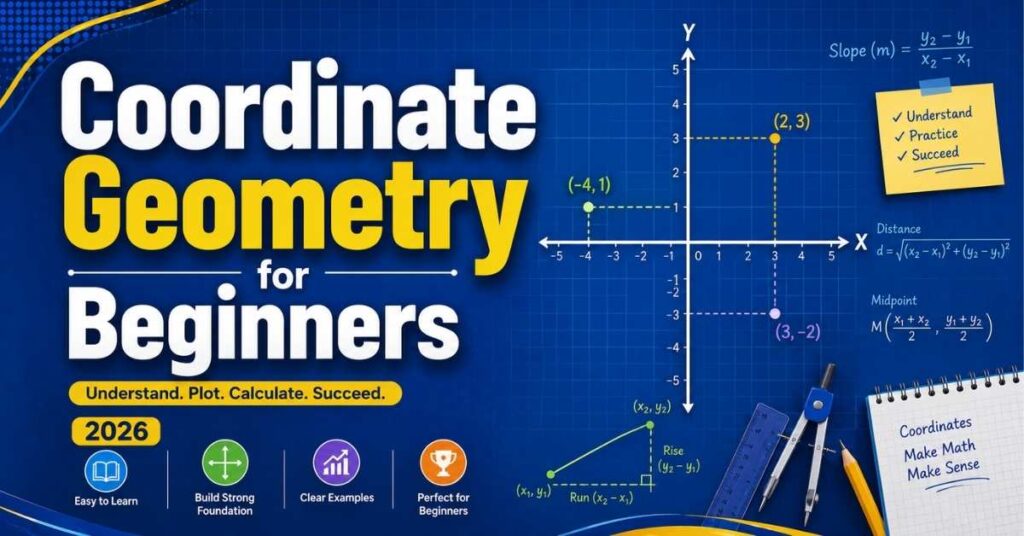
Coordinate geometry blends algebra and geometry to pinpoint exact locations on a graph. Rather than describing a spot in vague words, coordinates give you precise numbers that anyone can plot exactly the same way, every single time.
This system powers everything from classroom graphs to real-world GPS technology, which makes it one of the more practical corners of geometry you’ll ever learn.
Understanding the Coordinate Plane
The coordinate plane, sometimes called the Cartesian plane, is built from two number lines crossing at a single point called the origin, written as (0,0). Together, these lines split the entire plane into four separate quadrants.
The X-Axis and Y-Axis
The x-axis runs horizontally, while the y-axis runs vertically. Every point on the plane uses two numbers to describe its exact location, like the pair (5,3), which means moving five units across and three units up.
Plotting Points
Plotting points becomes second nature with practice. Start at the origin, move horizontally first, then move vertically, and mark your final spot. Do this a few dozen times, and it stops feeling like work entirely.
Distance Formula
The distance formula calculates the straight-line distance between any two coordinates. It plays a huge role in navigation, mapping, and computer graphics, wherever exact spacing between two points actually matters.
Midpoint Formula
The midpoint formula finds the exact halfway point between two coordinates. Surveyors, architects, and engineers use midpoint calculations constantly when designing balanced, evenly spaced structures.
Case Study: How GPS Uses Geometry
When your phone calculates the fastest route home, it isn’t guessing. GPS satellites pinpoint your exact position using precise navigation mathematics, measuring the distance between multiple satellites and your device before locking in your location. This entire process depends on map coordinates and digital mapping principles built directly on coordinate geometry. Without it, modern navigation simply wouldn’t function, and that single fact shows just how far geometry reaches beyond the classroom.
Symmetry, Congruence, Similarity, and Transformations
Shapes don’t just sit still. They can slide, flip, spin, and resize while keeping certain properties intact, and this entire branch of geometric transformations shows up constantly in architecture, animation, and logo design. Learning how geometric motion works adds a genuinely fun, dynamic layer to geometry that pure measurement can’t offer.
This section covers symmetry, congruent figures, similar figures, and the four core transformation types every beginner should recognize on sight.
Line Symmetry
A shape has line symmetry if a straight line can split it into two identical halves. Butterfly wings, leaves, and plenty of company logos all show off strong line symmetry.
Read More: Why Does Ozdikenosis Kill You? The Truth Behind the Viral Disease Search (2026 Guide)
Rotational Symmetry
A shape has rotational symmetry if it still looks exactly the same after being spun a certain number of degrees.
| Shape | Order of Rotational Symmetry |
| Square | 4 |
| Rectangle | 2 |
| Equilateral Triangle | 3 |
| Circle | Infinite |
Reflection
Reflection flips a shape across a line, creating a mirror image that keeps the exact same size and shape. Mirrors, calm lakes, and glass buildings all produce reflections you can spot in daily life.
Translation
Translation slides a shape from one spot to another without changing its size, angles, or orientation at all. Picture pushing a book across a table: the book moves, but nothing about its shape changes one bit.
Rotation
Rotation turns a shape around one fixed point, and the distance from that center point stays exactly the same throughout the movement. Clock hands, wind turbines, and mechanical gears all demonstrate rotation constantly.
Dilation
Dilation changes a shape’s overall size while keeping its proportions locked in place, making it either larger or smaller. Maps rely on dilation constantly, shrinking huge real-world areas down onto a single small sheet of paper.
Congruence
Congruent figures share the exact same size and the exact same shape, down to every angle and side length.
Similarity
Similar figures share the same shape but differ in size. Two photographs of the same picture printed at different sizes are a perfect example: similar, but not congruent.
Everyday Examples
Mobile app icons, road signs, and printed maps all rely on transformations, symmetry, congruence, and similarity working together behind the scenes.
Three-Dimensional Shapes You See Every Day
Flat shapes only cover length and width, but 3D shapes add a third dimension: height. That extra dimension means solid shapes carry actual volume, taking up real physical space rather than just sitting on a flat surface. Recognizing these solid figures helps connect geometry to the physical objects surrounding you every day.
From dice to soda cans, solid shapes are everywhere once you start looking for them. This section covers the seven most common ones you’ll encounter constantly.
Cube
A cube has six square faces, twelve edges, and eight vertices. Dice and storage boxes are the most familiar cube examples around.
Cuboid
A cuboid looks similar to a cube, but its faces are rectangles rather than perfect squares. Books, shipping boxes, and refrigerators are everyday cuboids.
Sphere
Every single point on a sphere’s surface sits the exact same distance from its center. Basketballs, marbles, and soap bubbles all take this perfectly round shape.
Cylinder
A cylinder has two identical circular bases connected by one curved surface. Water bottles, soda cans, and pipes are classic cylinder shapes.
Cone
A cone has a single circular base that narrows up to one pointed vertex. Ice cream cones, party hats, and traffic cones all share this shape.
Pyramid
A pyramid has one polygon base with triangular faces that meet together at a single top point. The ancient Egyptian pyramids remain some of the most famous geometric structures ever built.
Prism
A prism has two identical polygon bases connected by flat rectangular faces. Pencil boxes and certain crystal formations are natural prism examples.
Comparing 3D Shapes
| Solid | Faces | Edges | Vertices |
| Cube | 6 | 12 | 8 |
| Cuboid | 6 | 12 | 8 |
| Cylinder | 3 surfaces | 2 curved edges | 0 |
| Cone | 2 surfaces | 1 curved edge | 1 |
| Sphere | 1 curved surface | 0 | 0 |
Surface Area and Volume Overview
Surface area covers the outside of a solid, while volume measures the empty space held inside it. Wrapping a gift is a good way to picture the difference: the wrapping paper depends on surface area, while the room left inside the box depends on volume.
Geometry Formulas You Should Memorize
Memorizing geometry formulas gets a lot easier once you understand exactly where each one comes from. Rather than treating formulas as random strings of letters, connect each one back to the shape it actually measures, and suddenly they stop feeling so intimidating.
This section pulls together the most important formulas from every shape category covered so far, so you’ll have them all in one place for quick review.
Triangle Formulas
| Measurement | Formula |
| Area | ½ × base × height |
| Perimeter | Sum of all sides |
Quadrilateral Formulas
| Shape | Area Formula |
| Square | side² |
| Rectangle | length × width |
| Parallelogram | base × height |
| Trapezoid | ½(a + b) × height |
Circle Formulas
| Measurement | Formula |
| Circumference | 2πr |
| Area | πr² |
Solid Geometry Formulas
| Solid | Volume |
| Cube | side³ |
| Cuboid | length × width × height |
| Cylinder | πr²h |
| Cone | ⅓πr²h |
| Sphere | ⁴⁄₃πr³ |
Formula Cheat Sheet
Building a personal geometry cheat sheet from these tables is one of the smartest study habits you can develop. Keep it nearby during practice sessions, and over time you’ll notice you barely need to glance at it anymore.
Geometry in Everyday Life
Some people assume geometry stays locked inside a classroom, but that couldn’t be further from the truth. Everyday geometry touches nearly every modern industry, often in ways people never stop to notice.
From skyscrapers to smartphone apps, geometry quietly shapes the world running in the background of daily life.
Architecture
Geometry in architecture ensures buildings stay both attractive and structurally sound. Precise angles and measurements keep everything standing exactly the way it should.
Engineering
Geometry in engineering shows up constantly, since civil, mechanical, and aerospace engineers solve geometric problems every single day. Bridges, aircraft, and machines all depend on precise calculations to function safely.
Interior Design
Interior designers rely on interior design measurements to arrange furniture, calculate room dimensions, and balance visual space within a room.
Maps and GPS
Navigation systems constantly calculate angles, distances, and coordinates behind the scenes. Without geometry, digital maps simply wouldn’t work with any accuracy at all.
Geometry in Sports
Athletes use geometry constantly, often without realizing it. Bank shots in basketball, passing angles in soccer, and swing alignment in golf all rely on split-second geometric judgment.
Geometry in Gaming
Every 3D game world is built from thousands, sometimes millions, of geometric shapes. Computer graphics geometry lets developers construct characters, buildings, and entire landscapes out of simple polygons.
Geometry in Robotics
Geometry in robotics helps machines calculate distances, angles, and object positions before moving safely through their surroundings.
Geometry in Medical Imaging
Doctors rely on precise geometry in medical imaging technologies such as CT scans, MRI scanners, and ultrasound machines to build detailed, accurate images of the human body.
Read More: Best Pasticho Venezuelan Lasagna Near Me: Complete Guide to Authentic Venezuelan Pasticho (2026)
Geometry Patterns Found in Nature
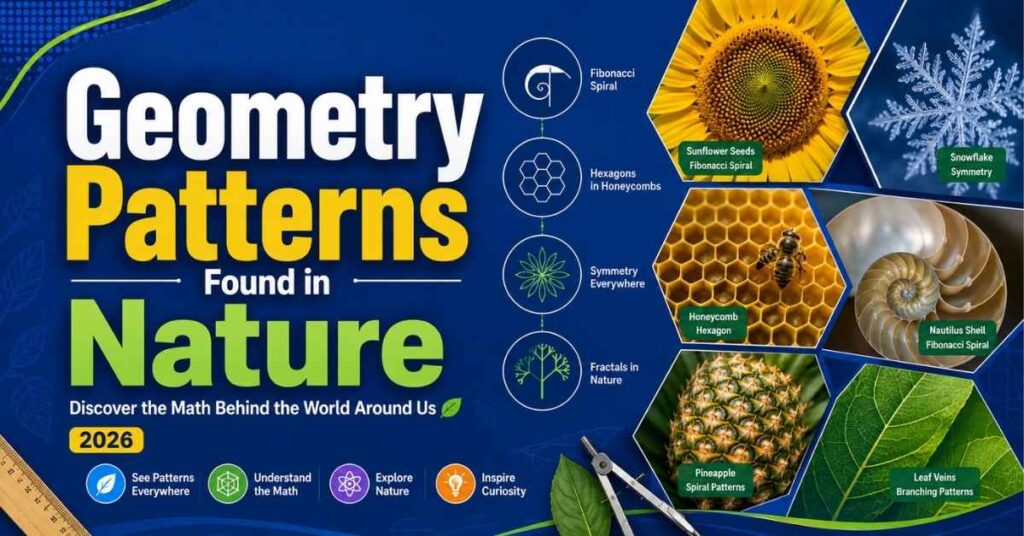
Nature figured out geometry long before humans ever wrote a single formula down. Recognizing these geometry in nature patterns makes the subject feel a lot more meaningful, and honestly, a lot more beautiful too.
From honeycombs to lightning bolts, natural geometric patterns repeat across the entire planet in remarkably consistent ways.
Honeycombs
Honeybees build hexagonal cells because hexagons hold the most honey while using the least amount of wax. This natural efficiency has inspired human engineers for decades.
Snowflakes
Almost every snowflake shows off six-sided symmetry. Each one stays completely unique, yet all of them follow the same underlying geometric blueprint.
Sunflowers
Sunflower seeds often grow in spiral patterns that pack the maximum number of seeds into the smallest possible space.
Spider Webs
Spider webs combine circles, triangles, and radial lines into one structure, delivering impressive strength while using a surprisingly small amount of silk.
Seashell Spirals
Many seashells grow in what’s called a logarithmic spiral, allowing continuous growth without ever changing the shell’s overall proportions.
Crystal Structures
Minerals naturally form geometric patterns as they crystallize. Diamonds, quartz, and salt all develop predictable shapes based purely on their molecular arrangement.
Fractals in Nature
Fractals are repeating patterns that appear at every scale, big or small. Fern leaves, coastlines, river networks, and lightning bolts all show this fractal behavior, proving that geometry isn’t just a human invention. It’s woven directly into the natural world.
Benefits of Learning Geometry
Beyond passing a test, geometry builds skills that stick with you for life. Strong geometry skills translate into sharper thinking across nearly every subject and career path you could pursue.
Here’s a closer look at exactly what you gain from sticking with geometry long term.
Improves Logical Thinking
Geometry trains your brain to follow logical thinking step by step, since every proof and calculation builds directly on the one before it.
Strengthens Problem-Solving Skills
Working through geometry problems sharpens your general problem-solving skills, teaching you to break big questions down into smaller, manageable pieces.
Helps in School and Competitive Exams
Geometry appears constantly on standardized tests, making solid geometry exam preparation genuinely valuable for students working toward college admissions.
Supports STEM Careers
STEM education leans heavily on geometry, particularly in engineering, architecture, computer science, and product design careers.
Makes Everyday Decisions Easier
From measuring furniture to estimating paint needed for a room, geometry quietly simplifies dozens of small daily decisions most people don’t even think twice about.
Proven Strategies to Learn Geometry Faster
Learning geometry doesn’t need to feel painful. With the right habits, you’ll build confidence and sharpen your geometry learning techniques far faster than you’d expect. Geometry Learn V3 always prioritizes understanding first, memorization second, and that order genuinely produces better long-term results.
The strategies below come from real classroom experience, and each one is simple enough to start using today.
Master the Basics First
Strong foundations make advanced topics far easier to grasp later. Before tackling complex proofs, make sure points, lines, basic shapes, and angle types feel completely natural.
Draw Every Problem
Geometry is a deeply visual subject. Sketching a quick diagram, even a rough one, often reveals relationships that plain text alone simply can’t show you.
Visualize Before Calculating
Pause before reaching for a calculator. Ask yourself what type of shape you’re looking at and which formula actually applies. This single habit cuts down on careless mistakes significantly.
Understand Formulas Instead of Memorizing
Connect every formula back to its real purpose instead of treating it as a random equation. Understanding why area measures the inside space, while perimeter measures the distance around it, makes recall dramatically easier come test day.
Solve Problems Daily
Consistency beats marathon study sessions every time. Even fifteen to twenty minutes of daily geometry practice builds real understanding over just a few weeks.
Use Digital Geometry Tools
Interactive apps let you rotate shapes and measure angles in real time, which speeds up visual geometry learning dramatically compared to reading alone.
Review Mistakes Regularly
Every wrong answer teaches you something valuable. Instead of just checking the correct solution, dig into why the mistake happened in the first place, whether it was a formula mix-up or a simple calculation slip.
Common Geometry Mistakes and How to Avoid Them
Even confident students trip up on geometry sometimes. The good news is that most geometry problems stem from a handful of predictable, totally avoidable mistakes.
Once you know what to watch for, these errors become far easier to catch before they cost you points.
Misreading Diagrams
Not every diagram is drawn perfectly to scale. Never assume two sides look equal just because they appear that way in a sketch.
Assuming Figures Are Drawn to Scale
This trips up more students than almost anything else. An angle might look like exactly 90 degrees on paper, but unless the problem states it directly, don’t assume it.
Confusing Perimeter, Area, and Volume
| Measurement | Question It Answers |
| Perimeter | How far around? |
| Area | How much surface? |
| Volume | How much space inside? |
Mixing Up Geometry Formulas
Keep a formula sheet handy until every equation feels second nature. Using the wrong formula almost always leads straight to an incorrect answer.
Incorrect Angle Calculations
Always double-check whether angles are complementary, supplementary, or governed by parallel-line rules before locking in a final answer.
Ignoring Measurement Units
Units genuinely matter. Length uses centimeters, area uses square centimeters, and volume uses cubic centimeters. Writing the wrong unit can cost you marks even when your actual math is correct.
Geometry Learn V3 Practice Plan
A structured routine keeps your geometry revision steady without ever feeling overwhelming. Building this habit early pays off enormously by exam time.
Beginner Practice Routine
Focus purely on fundamentals here: naming shapes, identifying angles, and getting comfortable with a ruler and protractor.
Intermediate Learning Schedule
Once the basics feel solid, move into triangle theorems, circle properties, coordinate geometry, and multi-step word problems a few times a week.
Advanced Challenge Exercises
Challenge yourself with problems that blend multiple concepts together, like coordinate geometry combined with circles, or composite figures requiring several formulas at once.
Weekly Revision Checklist
| Skill | Completed |
| Angle types | ☐ |
| Triangle properties | ☐ |
| Quadrilaterals | ☐ |
| Circle formulas | ☐ |
| Coordinate geometry | ☐ |
| Symmetry | ☐ |
| Surface area | ☐ |
| Volume | ☐ |
Geometry Learn V3 Quick Reference Tables
Keeping a geometry reference sheet close by makes revision noticeably faster. These four tables pull together the essentials from across the entire guide.
Common Geometry Symbols
| Symbol | Meaning |
| ∠ | Angle |
| ∥ | Parallel |
| ⊥ | Perpendicular |
| ≅ | Congruent |
| △ | Triangle |
| π | Pi |
Angle Relationships
| Relationship | Rule |
| Complementary | Sum = 90° |
| Supplementary | Sum = 180° |
| Vertical | Equal |
| Linear Pair | Sum = 180° |
Polygon Comparison Table
| Polygon | Sides |
| Triangle | 3 |
| Quadrilateral | 4 |
| Pentagon | 5 |
| Hexagon | 6 |
| Heptagon | 7 |
| Octagon | 8 |
| Nonagon | 9 |
| Decagon | 10 |
Essential Geometry Formulas
| Shape | Formula |
| Square Area | side² |
| Rectangle Area | length × width |
| Triangle Area | ½ × base × height |
| Circle Area | πr² |
| Circle Circumference | 2πr |
Frequently Asked Questions
What Is Geometry Learn V3?
Geometry Learn V3 is a step-by-step approach to learning shapes, angles, and measurement that prioritizes understanding over memorization, making it a genuinely useful geometry learning resource for beginners.
Is Geometry Learn V3 Suitable for Complete Beginners?
Yes, absolutely. It’s built specifically for geometry for beginners, introducing every concept gradually so nothing feels overwhelming from the start.
Can Geometry Learn V3 Help with School Exams?
It covers core topics taught across middle school, high school, and early college courses, making it genuinely useful for geometry exam preparation and general test readiness.
How Long Does It Take to Learn Basic Geometry?
Timelines vary by learner, but studying consistently for twenty to thirty minutes a day helps most beginners build solid understanding within just a few months.
Conclusion
Geometry isn’t some abstract subject stuck behind a classroom door. It’s a practical, everyday way of understanding the space around you, from the symmetry in a snowflake to the design of a skyscraper. Geometry Learn V3 gives you a clear, structured path through every core idea, without unnecessary complexity slowing you down.
The real key is simple: learn one concept at a time. Start with points, lines, and angles. Move on to shapes, formulas, and transformations after that. Before long, you’ll start spotting geometric figures almost everywhere you look, and geometry will stop feeling like a subject you have to study. It’ll just feel like a way of seeing the world.


