
Droven io Cloud Computing Guide: Features, Benefits & Step-by-Step Setup (2026)

Cloud computing runs the modern world, whether you notice it or not. Every time you stream a show, send a file to a coworker, or chat with an app powered by artificial intelligence, a server somewhere in a data center is doing the heavy lifting. You just don’t see it. This droven io cloud computing guide breaks down what cloud computing actually means, how it works under the hood, and how a resource like Droven.io helps you learn the skills that matter in 2026. We’ll walk through virtual machines, cloud storage, security, cost control, and a full step-by-step setup path, all in plain English.
By the end, you won’t just know the buzzwords. You’ll understand how compute resources, cloud networking, and cloud automation fit together, and why so many developers treat the droven.io cloud computing guide as a starting point for real DevOps skills.
What Is Droven.io?
Droven.io is a learning-focused resource built for people who want to understand cloud computing and DevOps without wading through dense technical manuals. It doesn’t try to compete with the big infrastructure providers. Instead, it explains how those providers work, how cloud migration happens in the real world, and how tools like Kubernetes and Docker fit into a modern deployment pipeline.
Think of Droven.io as a translator. It takes complicated ideas, like Infrastructure as Code or container orchestration, and turns them into something a beginner can actually follow. That’s the whole point of the droven io devops tutorials approach: teach the concept first, then show how it applies to real cloud workloads.
Why People Are Searching for Droven.io
Search interest in Droven.io has grown fast, and there’s a simple reason for it. Cloud jobs pay well, and companies want people who already understand cloud engineering basics before they’re hired. People search for the droven.io cloud computing guide because they want a single place that explains cloud adoption, security, and setup without forcing them to buy a course first.
Many readers land here after searching terms like “how does cloud computing work” or “AWS vs Azure for beginners.” They stay because the explanations connect directly to practical skills, not just theory.
Who Should Use Droven.io?
Droven.io works well for four kinds of readers. Students who want to break into tech. Developers who know how to code but not how to deploy. Small business owners planning a cloud transformation. And IT professionals brushing up on DevOps and automation pipelines before a certification exam.
You don’t need a computer science degree to benefit here. You need curiosity and a willingness to follow a guide step by step. That’s really it.
How Droven.io Simplifies Cloud Management
Cloud management gets complicated fast once you add identity and access management, networking rules, and cloud governance policies into the mix. Droven.io simplifies this by breaking every big topic into smaller, digestible pieces, so you build knowledge in layers instead of getting overwhelmed on day one.
Rather than throwing every setting at you at once, the guide walks through resource provisioning, security, and monitoring and observability in a logical order. That structure mirrors how real cloud engineers actually build environments, which makes the learning transfer directly to real-world work.
What Is Cloud Computing?
Cloud computing means renting computing power over the internet instead of buying and maintaining your own servers. You get virtual machines, cloud storage, databases, and networking on demand, and you only pay for what you actually use. No server room. No hardware repairs at 2 a.m.
This shift matters because it changes the entire cost structure of building software. A startup with no budget for physical servers can still launch a global product, because the shared infrastructure of a cloud provider does the heavy lifting for a fraction of the cost.
Cloud Computing Explained in Simple Terms
Picture electricity. A hundred years ago, factories generated their own power on-site. Today, everyone just plugs into the grid and pays for what they use. Cloud computing works the same way. Instead of running your own data centers, you plug into a provider’s infrastructure and draw exactly the resources you need.
This is often called utility computing, because it behaves like a utility bill rather than a capital purchase. You don’t own the pipes. You just pay for the water that flows through them.
Read More: Geometry Learn V3: The Ultimate Beginner’s Guide to Shapes & Angles (2026)
Traditional Computing vs. Cloud Computing
The differences show up clearly once you line them up side by side.
| Factor | Traditional Infrastructure | Cloud Computing |
| Upfront Cost | High, hardware purchased outright | Low, pay-as-you-go pricing |
| Setup Time | Weeks or months | Minutes to hours |
| Scaling | Manual and slow | Auto scaling and elastic scaling |
| Maintenance | Handled in-house | Handled by the provider |
| Disaster Recovery | Expensive to build | Often built in |
| Global Reach | Limited by physical location | Instant access across regions |
Why Cloud Computing Matters More Than Ever in 2026
Artificial intelligence is the biggest driver of cloud growth right now. Training a modern AI model needs massive high performance computing power, and very few companies can afford to build that kind of AI infrastructure on their own. Renting it from a cloud provider makes the economics work.
At the same time, remote work has made remote infrastructure access a basic requirement, not a luxury. Employees expect to log in securely from anywhere, and cloud platforms make that possible without a tangle of custom VPN setups for every single tool.
How Cloud Computing Works
Behind every cloud platform sits a physical data center packed with servers. Virtualization software splits that hardware into many independent virtual servers, so multiple customers can share the same physical machine without ever seeing each other’s data. This is the backbone of distributed computing at scale.
When you launch a server in the cloud, you’re not buying a box. You’re requesting a slice of shared hardware that can grow or shrink the moment your needs change. That flexibility is what makes cloud scalability possible in the first place.
Compute Resources
Compute resources are the engines that run your applications. This includes virtual machines, containers, and serverless functions. Each option trades off control for convenience differently, and picking the right one depends on your workload.
A virtual machine gives you a full operating system to manage yourself. A container packages your app with just what it needs to run, nothing more. Serverless functions skip infrastructure entirely and just execute your code when triggered. All three fall under the umbrella of cloud workloads.
Storage Systems
Cloud storage isn’t one-size-fits-all. Object storage handles unstructured files like images, videos, and backups. Block storage attaches directly to a virtual machine, much like a hard drive. File storage lets multiple systems share the same folder structure at once.
Choosing the wrong type can hurt both performance and your monthly bill. A database needs fast block storage. A media library is usually cheaper and simpler as object storage.
Networking
Cloud networking connects everything together. A Virtual Private Cloud (VPC) isolates your resources from everyone else on the platform. A cloud firewall filters traffic in and out. A load balancer spreads incoming requests across multiple servers so no single machine gets overwhelmed.
Route tables direct traffic between subnets, and DNS services translate domain names into the actual server addresses behind them. Get these settings wrong, and your app either becomes unreachable or, worse, exposed to the public internet by accident.
Identity and Security Controls
Every cloud account needs strict rules about who can do what. Identity and Access Management, usually shortened to IAM, controls this. Role-Based Access Control assigns permissions based on job function instead of handing out blanket admin rights to everyone.
Good IAM setup follows the least privilege principle: give people only the access they need, nothing extra. This single habit prevents a huge share of cloud security incidents before they ever happen.
Monitoring and Automation
Cloud monitoring and cloud logging track what’s happening across your environment in real time. Cloud analytics turns that raw data into patterns you can actually act on. Combine that with cloud automation and cloud orchestration, and routine tasks like scaling or patching happen without anyone lifting a finger.
This is where automation pipelines shine. Instead of manually restarting a failed server, an automated system detects the failure and fixes it in seconds, often before a human even notices.
Cloud Service Models Explained
Cloud services generally fall into four categories, and each one hands off a different amount of responsibility to the provider. Understanding these models helps you pick the right tool instead of overpaying for control you don’t actually need.
The four models are Infrastructure as a Service, Platform as a Service, Software as a Service, and Function as a Service. Each one sits at a different point on the spectrum between “you manage everything” and “the provider manages everything.”
Infrastructure as a Service (IaaS)
Infrastructure as a Service gives you the raw building blocks: virtual machines, storage, and networking. You install the operating system, manage updates, and configure security yourself. The provider only handles the physical hardware underneath.
This model suits teams who want maximum control over their environment. It’s also the closest thing to traditional server management, just without owning the physical machines.
Platform as a Service (PaaS)
Platform as a Service removes server management almost entirely. You upload your application, and the platform handles the runtime, scaling, and security patches automatically.
Developers love PaaS because it speeds up software development significantly. You spend your time writing features instead of configuring servers.
Software as a Service (SaaS)
Software as a Service delivers a finished product through a browser. Email platforms, video conferencing tools, and CRM systems are classic examples. You don’t install anything or manage any infrastructure at all.
This is the model most non-technical users interact with daily, often without even realizing it’s cloud-based.
Function as a Service (FaaS) / Serverless Computing
Function as a Service, also known as Serverless Computing, runs your code only when something triggers it. There’s no server sitting idle waiting for traffic. This model has become the default choice for microservices, APIs, and event-driven apps because it scales instantly and costs nothing when idle.
Cloud Deployment Models
Beyond service models, you also need to decide where your infrastructure physically lives and who shares it. This decision shapes cost, control, and compliance all at once.
Four deployment models dominate the industry today: public, private, hybrid, and multi-cloud. Each fits a different mix of budget, security needs, and regulatory pressure.
Public Cloud
A public cloud shares infrastructure among many customers on the same physical hardware, separated logically through virtualization. It’s the cheapest and fastest option to get started with, which makes it popular for startups and general web applications.
Private Cloud
A private cloud dedicates infrastructure to a single organization. Banks, government agencies, and healthcare providers often choose this route because it gives them tighter control over cloud compliance and data handling.
Hybrid Cloud
Hybrid cloud blends public and private infrastructure. Sensitive data stays on private systems while less sensitive workloads run on cheaper public resources. This gives organizations flexibility without giving up control where it matters most.
Multi-Cloud Strategy
A multi-cloud strategy spreads workloads across more than one provider at the same time. Companies do this to avoid depending on a single vendor, improve fault tolerance, and negotiate better pricing across the board.
Deployment Model Comparison Table
| Model | Cost | Control | Best For |
| Public Cloud | Low | Shared | Startups, web apps |
| Private Cloud | High | Full | Banks, healthcare, government |
| Hybrid Cloud | Medium | Mixed | Regulated industries with variable workloads |
| Multi-Cloud | Varies | Distributed | Large enterprises avoiding vendor lock-in |
Core Features of Droven.io
The droven.io cloud computing guide walks readers through the same building blocks that real cloud platforms use, so the knowledge transfers directly to any provider you end up choosing. Rather than locking you into one vendor’s tools, it teaches the underlying concepts behind infrastructure provisioning, deployment, and scaling in a provider-neutral way.
That approach matters because cloud skills age poorly if they’re tied to one dashboard. Learning the “why” behind elastic resource scaling or backup and disaster recovery means you can apply that knowledge on AWS, Azure, Google Cloud, or wherever your career takes you next.
Infrastructure Provisioning
Provisioning means requesting and configuring the resources your application needs, from virtual machines to storage volumes. The guide explains how this process works conceptually, so you understand what’s happening every time you click “create” in a real cloud console.
Automated Application Deployment
Application deployment used to mean manually copying files onto a server. Modern workflows automate this through CI/CD pipelines, pushing code from a repository straight into production with Continuous Integration and Continuous Deployment steps handling testing and release along the way.
Elastic Resource Scaling
Elastic scaling adjusts resources automatically based on demand. Traffic spikes during a sale, and the system adds capacity. Traffic drops overnight, and it scales back down. This keeps performance steady without paying for capacity you don’t need most of the time.
Monitoring and Observability
Monitoring and Observability go beyond simple uptime checks. They track response times, error rates, and resource usage so you catch problems before customers do. Performance Optimization depends heavily on having this visibility in place.
Security Controls
Security controls cover encryption at rest, encryption in transit, firewalls, and access policies. The guide treats security as a foundation, not an afterthought, which matches how serious cloud teams actually operate.
Backup and Disaster Recovery
A solid backup strategy protects you when something goes wrong, whether that’s human error, hardware failure, or a cyberattack. Cloud disaster recovery planning ensures you can restore service quickly instead of losing days of data and revenue.
API Integrations
API Integration connects your application to other services, databases, and third-party tools. Nearly every modern cloud workflow depends on APIs talking to each other behind the scenes.
Major Benefits of Cloud Computing
The advantages of moving to the cloud go far beyond a smaller hardware bill. Businesses gain speed, flexibility, and reach that used to be reserved for companies with massive IT budgets.
Cost savings matter, sure, but the bigger win is agility. Teams launch products faster, recover from failures quicker, and reach customers anywhere in the world without building anything physical.
| Benefit | What It Means |
| Lower Infrastructure Costs | No upfront hardware spending, just usage-based billing |
| Faster Application Deployment | Launch in hours instead of weeks |
| Better Scalability | Resources grow and shrink automatically with demand |
| Improved Collaboration | Teams access shared tools from anywhere |
| High Availability | Redundant systems keep services running |
| Business Continuity | Backups and failover reduce downtime risk |
| Better Performance | Global networks reduce latency |
| Global Accessibility | Users connect from any region |
As one industry analyst put it, “Cloud computing isn’t just a technology upgrade. It’s the foundation nearly every modern digital service now stands on.”
Why Developers and Businesses Choose Droven.io
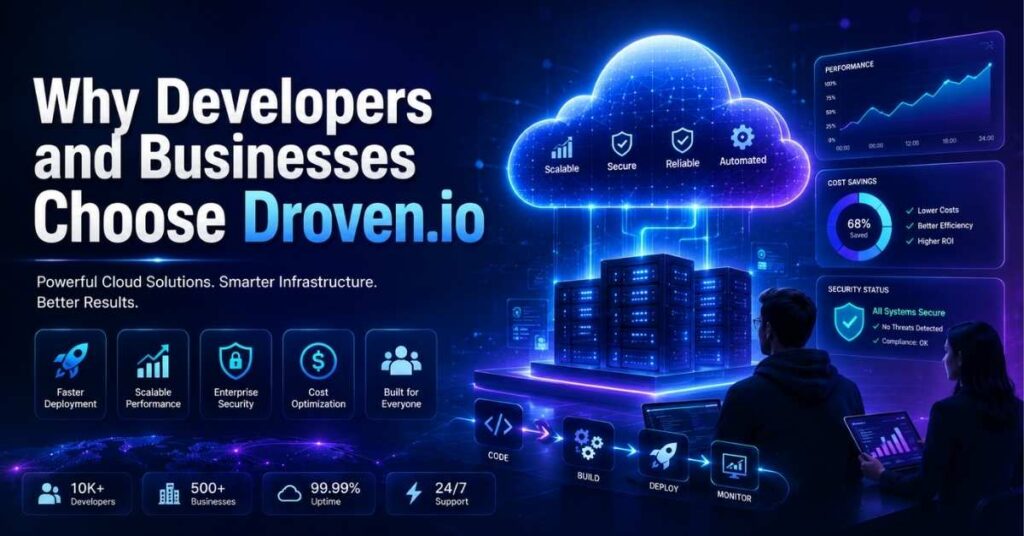
Developers gravitate toward the droven.io cloud computing guide because it respects their time. Instead of vague marketing language, it explains concepts with enough technical depth to actually be useful on the job, while still staying approachable for beginners.
Businesses value it for a different reason: it helps teams build cloud literacy before spending money on expensive consultants or courses. That translates into faster hiring decisions and fewer costly mistakes during cloud transformation projects.
Faster Infrastructure Deployment
Clear explanations mean less trial and error. Teams that understand the “why” behind each step deploy infrastructure faster because they aren’t guessing their way through documentation.
Reduced Operational Complexity
Breaking big topics into smaller lessons reduces the mental overload that usually comes with infrastructure management. Complexity doesn’t disappear, but it becomes manageable.
Better Resource Efficiency
Understanding resource pooling and right-sizing prevents the common trap of over-provisioning servers “just in case.” That knowledge alone often pays for itself within the first billing cycle.
Improved Visibility
Learning how cloud monitoring and cloud logging work gives teams the visibility they need to catch issues early, rather than discovering problems only after customers complain.
Cost Optimization
Cost Optimization becomes second nature once you understand how billing actually works across compute, storage, and network traffic. Small habits, like shutting down idle resources, add up to real savings over a year.
Read More: Best Pasticho Venezuelan Lasagna Near Me: Complete Guide to Authentic Venezuelan Pasticho (2026)
Step-by-Step Guide: Setting Up Droven.io in 2026
Setting up a cloud environment sounds intimidating until you break it into stages. Follow these steps in order, and you’ll end up with a secure, working foundation instead of a messy pile of half-finished settings.
| Step | Action | Why It Matters |
| 1 | Create your account | Verifies identity and enables billing alerts |
| 2 | Create your first project | Keeps resources organized from day one |
| 3 | Configure IAM | Controls who can access what |
| 4 | Configure networking | Sets up your VPC, subnets, and firewall rules |
| 5 | Configure storage | Chooses the right storage type for your workload |
| 6 | Deploy compute resources | Launches your virtual machines or containers |
| 7 | Apply security policies | Locks down access before going live |
| 8 | Deploy your application | Pushes code into the live environment |
| 9 | Enable monitoring and logging | Gives you visibility into performance |
| 10 | Create backup and disaster recovery policies | Protects data against loss |
| 11 | Test and optimize performance | Confirms everything works as expected |
Step 1: Create Your Account
Start by signing up and verifying your identity. Turn on Multi-Factor Authentication immediately. This one step blocks the vast majority of account takeover attempts before they even start.
Step 2: Create Your First Project
A project acts as a container for related resources. Organizing work this way from the beginning saves enormous headaches later, especially once you’re managing more than one application.
Step 3: Configure Identity and Access Management (IAM)
Set up individual user accounts instead of sharing one login. Apply Role-Based Access Control so each person only sees what their job requires. This is the least privilege principle in action.
Step 4: Configure Networking
Build your Virtual Private Cloud, define subnets, and set firewall rules. Configure route tables so traffic flows exactly where it should, and nowhere else.
Step 5: Configure Storage
Match your storage type to your workload. Databases need fast block storage. Media files usually work better and cheaper as object storage. Shared documents belong in file storage.
Step 6: Deploy Compute Resources
Choose between virtual machines, containers, or serverless functions based on your app’s needs. Docker packages your app consistently across environments, while Kubernetes manages scaling and recovery if you’re running many containers at once.
Step 7: Apply Security Policies
Turn on encryption at rest and encryption in transit. Restrict administrative access to only the people who truly need it, and review those permissions regularly.
Step 8: Deploy Your Application
Push your code live using an automated pipeline instead of manual uploads. A proper CI/CD setup catches bugs before they reach production and rolls back automatically if something breaks.
Step 9: Enable Monitoring and Logging
Turn on cloud monitoring for CPU, memory, and network usage. Set alerts so your team hears about problems within minutes, not days.
Step 10: Create Backup and Disaster Recovery Policies
Automate backups on a schedule, and store copies in more than one location. A good backup strategy follows the 3-2-1 rule: three copies of your data, on two different types of storage, with one copy kept offsite.
Step 11: Test and Optimize Performance
Run load tests, confirm your failover works, and check that auto scaling kicks in correctly under pressure. Treat this as an ongoing habit, not a one-time task.
Beginner Checklist for Your First Cloud Deployment
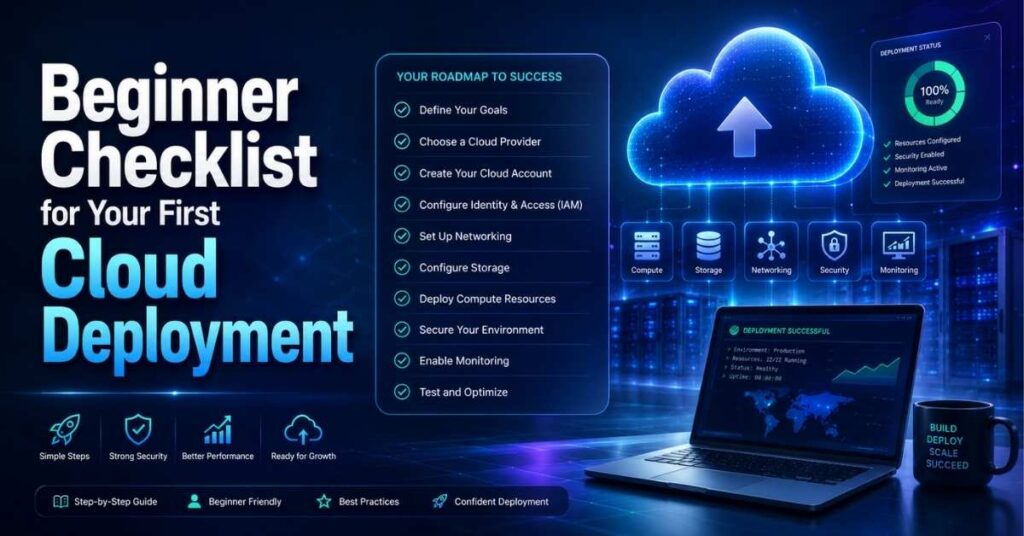
Before launching anything into production, confirm the basics are in place. Multi-Factor Authentication should be active on every account. Backups should run automatically and get tested at least once. IAM roles should follow least privilege. Storage types should match actual workload needs. Monitoring and alerts should already be live before real users show up. Firewalls should block everything except traffic you explicitly allow. Documentation should exist somewhere your whole team can find it. Check every item on this list twice, because fixing a security gap after launch is always harder than preventing it beforehand.
Real-World Cloud Computing Use Cases
Cloud computing quietly powers services that most people use every single day, often without ever thinking about what’s happening behind the screen.
Small Businesses
Small businesses host websites, email, and accounting software in the cloud instead of buying servers they can’t afford to maintain. This levels the playing field against much larger competitors.
SaaS Platforms
SaaS companies build their entire product on cloud infrastructure, scaling automatically as their customer base grows without ever touching physical hardware.
E-Commerce Stores
Online stores lean on auto scaling to survive traffic spikes during events like Black Friday. Without it, sudden demand would crash the site entirely.
Healthcare
Hospitals use cloud infrastructure for electronic health records, medical imaging, and telemedicine, all while maintaining strict HIPAA compliance.
Education
Universities deliver online classes, research computing, and digital libraries through the cloud, giving students access from anywhere in the world.
Financial Services
Banks rely on cloud platforms for fraud detection, risk analysis, and mobile banking, backed by strict security and GDPR-aligned data handling.
AI and Machine Learning
Training modern AI models requires massive machine learning infrastructure, often thousands of GPUs working together. Renting this from a cloud provider is far cheaper than buying it outright.
Development and Testing Environments
Developers spin up temporary environments for testing, then tear them down when finished, paying only for the hours actually used.
Enterprise Applications
Large organizations run complex enterprise applications across multiple regions, relying on high availability to keep operations running around the clock.
Cloud Security Best Practices
Security in the cloud is a shared responsibility. The provider secures the underlying infrastructure, but you’re responsible for configuring your own environment correctly.
Following a handful of consistent habits prevents the overwhelming majority of cloud security incidents, and none of them require advanced technical skill to implement.
Enable Multi-Factor Authentication (MFA)
Passwords alone aren’t enough anymore. Multi-Factor Authentication adds a second verification step that stops most account takeover attempts cold.
Follow the Principle of Least Privilege
Give every user only the access they actually need. The least privilege principle limits the damage a compromised account can do.
Encrypt Data at Rest and in Transit
Use encryption at rest for stored data and encryption in transit for data moving across networks. This protects information even if someone intercepts it.
Network Segmentation
Split your network into isolated sections so a breach in one area can’t spread freely into everything else.
Secure Backups
Encrypt your backups just like your live data. A backup that’s easy to steal defeats the entire purpose of having one.
Continuous Monitoring
Watch for unusual logins, unexpected configuration changes, and suspicious traffic patterns around the clock, not just during business hours.
Compliance and Data Privacy
Understand which regulations apply to your data, whether that’s GDPR, HIPAA, or another regional privacy law, and configure your environment to meet them from day one.
Common Cloud Security Risks and How to Prevent Them
Most cloud breaches trace back to a small handful of preventable mistakes rather than sophisticated hacking.
Weak Access Controls
Shared admin logins and overly broad permissions make it easy for one compromised account to cause widespread damage. Individual accounts with Role-Based Access Control fix this.
Misconfigured Resources
A storage bucket left open to the public internet is one of the most common causes of data leaks. Always review default settings before deploying anything.
Data Exposure
Sensitive information stored without encryption is exposed the moment an attacker gains any access at all. Encryption should never be optional.
Ransomware Risks
Ransomware spreads fastest across poorly segmented networks with weak backup practices. Regular, isolated backups are your best defense.
Insider Threats
Not every risk comes from outside. Employees with excessive access can cause damage, whether accidental or intentional, which is another reason least privilege matters so much.
Cloud Cost Optimization Strategies
Cloud bills grow out of control when resources run unchecked. A few consistent habits keep spending predictable and lean.
Right-Size Resources
Many teams provision virtual machines far larger than what they actually need. Regular reviews catch this waste before it becomes a habit.
Enable Auto Scaling
Auto scaling matches resource use to actual demand, instead of running at maximum capacity around the clock just in case.
Shut Down Idle Resources
Development and testing servers often stay online overnight or on weekends for no reason. Automating shutdowns during idle hours saves real money.
Choose the Right Storage Tier
Not every file needs premium, high-speed storage. Move older or rarely accessed data into cheaper archive tiers.
Monitor Resource Usage
Regular reviews of compute, storage, and network usage catch problems before they show up as a surprise on your monthly invoice.
Avoid Hidden Cloud Costs
Data transfer fees, unused snapshots, and forgotten load balancers quietly inflate bills. Audit your environment on a regular schedule to catch these before they add up.
Cloud Cost Optimization Checklist
Review virtual machine sizes every quarter. Confirm auto scaling rules match actual traffic patterns. Shut down or schedule non-production environments outside business hours. Move cold data to archive storage tiers. Set budget alerts on every project. Review data transfer costs monthly. Delete unused snapshots and orphaned storage volumes without exception.
Common Cloud Computing Mistakes to Avoid
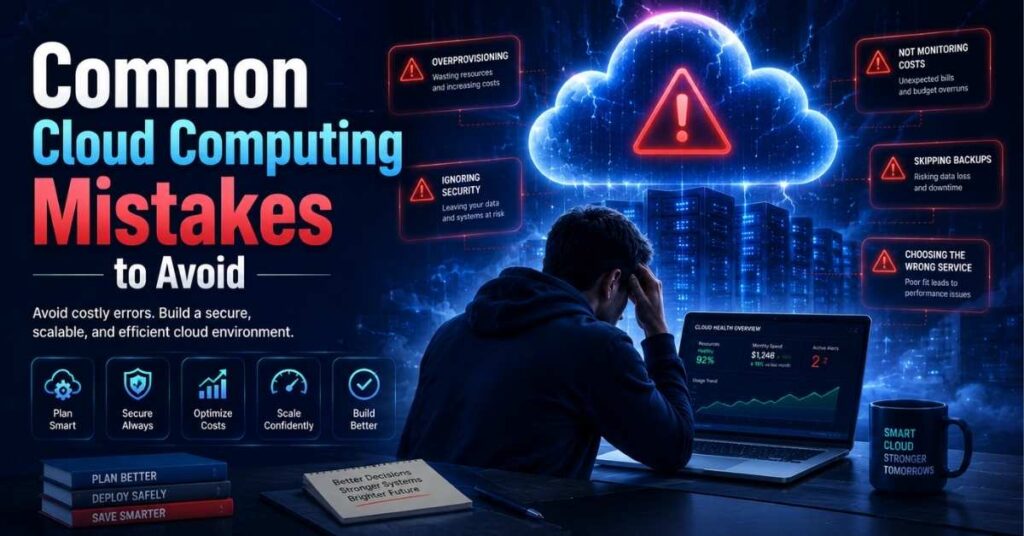
Even experienced teams fall into predictable traps when managing cloud environments.
Overprovisioning Resources
Buying more capacity than needed “just to be safe” wastes money every single month without adding real value.
Ignoring Security Best Practices
Leaving default settings unchanged is one of the most common causes of cloud breaches. Always review security configurations before going live.
Choosing the Wrong Service Model
A simple website doesn’t need a full Kubernetes cluster. Match your service model to the actual complexity of your workload.
Failing to Monitor Costs
Resources left running unmonitored quietly rack up charges for weeks before anyone notices.
Poor Backup Planning
Creating backups isn’t enough on its own. Test your restoration process regularly, or you might discover it doesn’t actually work when you need it most.
Neglecting Documentation
Undocumented environments slow down troubleshooting and make onboarding new team members painfully slow.
Skipping Performance Monitoring
Without ongoing monitoring, small performance issues go unnoticed until they turn into major outages.
Droven.io vs Traditional Hosting
Traditional hosting locks you into fixed capacity and manual scaling. Droven.io’s teaching approach centers on modern cloud principles instead, where resources adjust automatically and management happens through automation rather than manual server work.
Comparison Table
| Factor | Traditional Hosting | Cloud-Based Approach (Droven.io Guide) |
| Scaling | Manual, slow | Elastic scaling, automatic |
| Setup Time | Days or weeks | Minutes to hours |
| Maintenance | Manual patching | Largely automated |
| Cost Model | Fixed monthly fee | Usage-based pricing |
| Disaster Recovery | Often manual | Built-in options available |
Droven.io vs Major Cloud Platforms
Droven.io isn’t a cloud infrastructure provider itself. It’s a guide that teaches the concepts behind platforms like AWS, Azure, and Google Cloud, so you can apply that knowledge on whichever provider you choose.
Droven.io vs AWS
AWS offers one of the largest catalogs of cloud services in the industry. Droven.io teaches the underlying concepts that make AWS services make sense, without locking you into one vendor’s terminology.
Droven.io vs Microsoft Azure
Azure integrates tightly with Microsoft’s enterprise tools. Understanding core cloud concepts through Droven.io first makes Azure’s specific implementation easier to pick up quickly.
Droven.io vs Google Cloud Platform
Google Cloud leans heavily into AI and data analytics workloads. The foundational knowledge from Droven.io applies just as well here, since concepts like auto scaling and IAM work similarly across providers.
Feature Comparison Matrix
| Aspect | Droven.io | AWS / Azure / GCP |
| Purpose | Educational guide | Actual cloud infrastructure provider |
| Cost | Free to learn from | Usage-based billing |
| Hands-On Infrastructure | No | Yes |
| Best Use | Learning core concepts | Running real production workloads |
Challenges and Limitations of Cloud Computing
Cloud computing isn’t perfect. Understanding its limits helps you plan around them instead of getting caught off guard later.
Internet Dependency
Cloud services need a stable internet connection. Poor connectivity directly limits access to hosted applications, which is why many organizations maintain backup connections.
Vendor Lock-In
Proprietary tools and APIs can make switching providers difficult later. Using open standards and containers whenever possible reduces this risk significantly.
Compliance Challenges
Meeting regulations like GDPR or HIPAA requires proper configuration on your end. The provider gives you the tools, but compliance itself is still your responsibility.
Unexpected Costs
Idle resources, large data transfers, and forgotten snapshots can quietly inflate a bill far beyond initial estimates.
Managing Multi-Cloud Complexity
Running workloads across multiple providers adds real operational overhead, since each platform has its own tools, dashboards, and quirks to learn.
How to Choose the Right Cloud Provider
Picking a provider comes down to matching their strengths to your actual needs, not just picking the biggest name in the market.
Performance
Look at network speed, latency, and uptime history across the regions your users actually live in.
Security
Check for strong encryption standards, robust IAM tools, and relevant compliance certifications before committing.
Pricing
Understand compute, storage, and data transfer costs in detail. Pricing pages often hide the real cost until you dig into the fine print.
Scalability
Confirm that resources can expand automatically as demand grows, without requiring manual intervention every time.
Global Infrastructure
More regions generally mean better performance for users spread across different countries.
Customer Support
Responsive support matters most during an actual outage, not during a sales call. Check reviews focused specifically on support response times.
Case Study: How a Startup Reduced Infrastructure Costs Using Cloud Computing
A software startup once ran several physical servers out of a small rented office. As demand grew, hardware maintenance became a constant drain, and deployments slowed to a crawl. The team migrated to a cloud environment built around virtual machines, managed databases, object storage, and automated backups.
Within twelve months, infrastructure costs dropped by roughly 35 percent. Deployment speed improved from hours down to minutes. System availability climbed above 99.9 percent, and backup recovery time shrank from hours to just minutes. The company also expanded into new regions without ever purchasing new physical hardware, freeing developers to spend their time building features instead of babysitting servers.
Cloud Computing Trends Shaping 2026
Cloud technology keeps moving fast, and several trends stand out heading into 2026.
AI-Powered Cloud Operations (AIOps)
Artificial intelligence now predicts hardware failures, optimizes spending, and flags unusual network activity before human teams even notice a problem.
Edge Computing Expansion
Edge Computing moves processing closer to users instead of routing everything through distant data centers, cutting latency for IoT devices and real-time applications.
Serverless Computing Growth
More teams adopt Serverless Computing every year because it removes server management entirely and scales automatically with actual usage.
Kubernetes Becomes the Standard
Kubernetes has become the default choice for container orchestration, helping teams deploy, scale, and recover applications consistently across environments.
Zero-Trust Security
Zero Trust Security assumes no user or device is automatically trustworthy, verifying every request continuously rather than granting broad access after a single login.
Sustainable Green Cloud Infrastructure
Providers keep investing in renewable energy and efficient data centers, making sustainability a genuine factor in provider selection for many organizations.
Autonomous Resource Optimization
Systems increasingly adjust their own resource allocation in real time, reducing waste without requiring constant manual tuning.
Multi-Cloud Adoption
More businesses spread workloads across multiple providers to improve resilience and avoid depending too heavily on any single vendor.
Frequently Asked Questions
What is Droven.io used for?
Droven.io is used as a learning resource for understanding cloud computing and DevOps concepts, including Infrastructure as a Service, security practices, and deployment workflows.
What is the Droven.io Cloud Computing Guide?
The droven.io cloud computing guide is an educational resource that explains cloud fundamentals, deployment models, security, and setup steps in plain, approachable language.
What security features should every cloud deployment have?
Every deployment should include Multi-Factor Authentication, encryption at rest and encryption in transit, least privilege access controls, and continuous monitoring.
What is the difference between cloud hosting and traditional hosting?
Cloud hosting scales automatically and bills based on usage, while traditional hosting relies on fixed capacity and manual scaling that takes far longer to adjust.
Does Droven.io support automated scaling?
Droven.io teaches the concepts behind auto scaling and elastic scaling, which apply directly to real cloud providers like AWS, Azure, and Google Cloud.
What are the biggest cloud computing challenges in 2026?
The biggest challenges include managing multi-cloud complexity, avoiding vendor lock-in, staying compliant with regulations like GDPR and HIPAA, and keeping costs predictable as usage scales.
Conclusion
Cloud computing has reshaped how businesses build, deploy, and manage technology, and that shift shows no signs of slowing down in 2026. This droven.io cloud computing guide walked through the core concepts, from virtual machines and cloud storage to security, cost control, and a full setup path you can actually follow.
Whether you’re launching your first website, scaling an enterprise application, or deepening your DevOps knowledge, understanding these fundamentals gives you a real advantage. Cloud computing isn’t a passing trend. It’s the infrastructure quietly running modern software, artificial intelligence, and digital services that people depend on every day, and the people who understand it well today will be the ones building what comes next.


